


How ADM and Klim built a scalable regenerative agriculture programme
Expanding re:generations™ from North America into Germany by combining ADM's established sourcing network and farmer relationships with Klim's local implementation and MRV expertise.
Turn re:generations™ into a scalable customer offering
ADM wanted to expand re:generations™ into Europe and create an offering that could serve growing downstream demand for regenerative agriculture. The model needed to build on ADM's existing sourcing network and farmer relationships while delivering credible, measurable outcomes for its customers.

Built at scale. Delivered with quality. Ready to grow.
Building a programme designed to grow
ADM had already proven the value of its re:generations™ programme in North America. Expanding into Europe meant adapting the programme to different farming systems, regulations and customer expectations without losing the strengths of the existing model.
Rather than simply replicating its North American model, ADM wanted to build a programme designed for long-term scale. The objective was to create a regenerative transition program with rigorous MRV, inventory accounting for carbon metrics, and planned for continuous improvement, as well as horizontal and vertical collaboration. Farmers should be trained and incentivised to reduce emissions, improve soil health, biodiversity areas, and overall farm resilience .
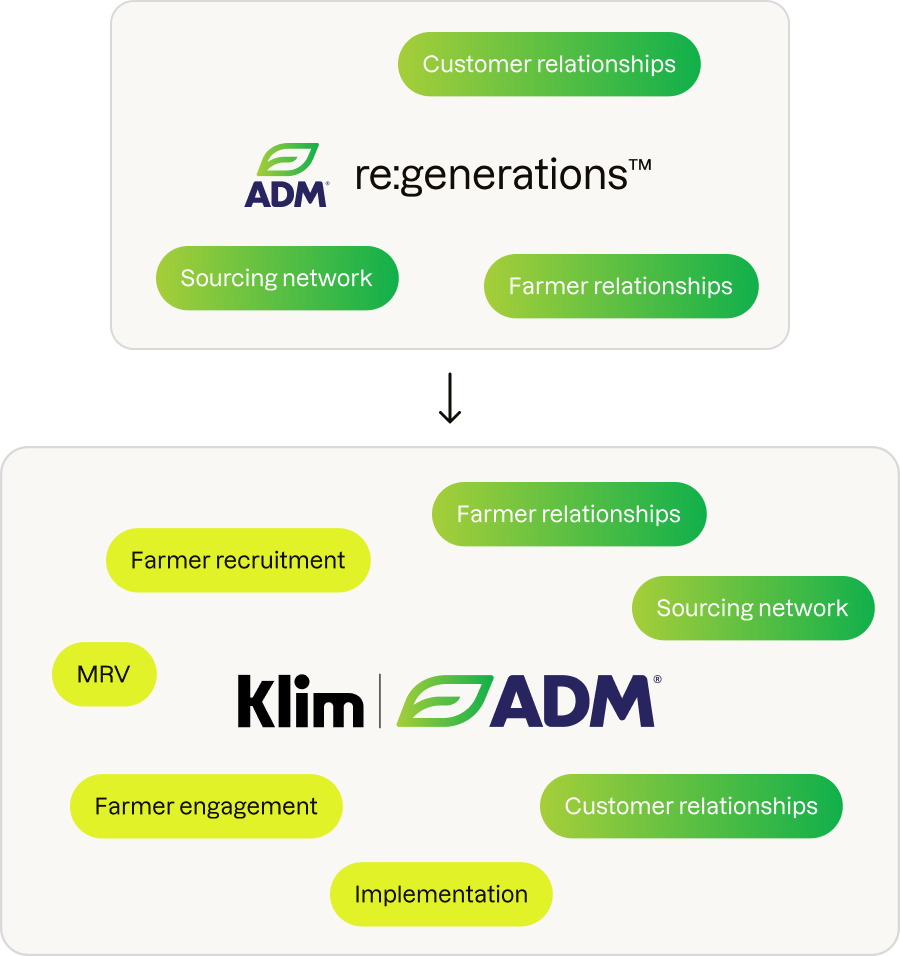
With the programme architecture defined, Klim built around ADM's existing supply chain and capabilities rather than replacing them. ADM and Klim combined their farmer networks and recruitment efforts, while Klim added farmer onboarding, programme management, local implementation and in-house MRV.
A modular setup and adaptable farmer incentive model allow the programme to accommodate different sourcing regions, farmer profiles and levels of regenerative experience without rebuilding the programme from scratch.
The success of the programme depended on engaging farmers and helping them adopt regenerative practices that fit their operations.
Working directly with participating growers, Klim supported farmer onboarding and guided the implementation of practices such as cover cropping, conservation tillage, 4R nutrient management, companion cropping and biodiversity measures. These practices improve soil health while reducing greenhouse gas emissions and increasing carbon sequestration.
Building on ADM's long-standing grower relationships, the programme was designed not only to drive participation, but to support farmers in progressing their regenerative practices over time.
Credible programme outcomes require more than implementing regenerative practices, they require consistent measurement, transparent reporting and a clear connection to the supply chain.
Klim's in-house MRV quantifies greenhouse gas reductions and carbon removals using whole-farm primary data and an inventory accounting approach aligned with the GHG Protocol, Land Sector and Removals Standard and ISO 14067. Soil carbon changes are modelled using a regionally adapted RothC model calibrated with German soil, climate and farm management data.
Because the programme is built around ADM's actual sourcing network, farm-level outcomes can be robustly linked back to the supply chain they originate from, strengthening traceability and confidence in downstream Scope 3 reporting and claims. And because participating farms are onboarded and monitored across their crop rotations, the same data and implementation foundation can support multiple commodities and customer requirements over time.
For downstream customers, this turns an established regenerative agriculture programme into ready-to-use infrastructure: providing transparent sustainability data and regenerative commodity solutions while reducing the upfront investment, execution risk and time required to deliver measurable Scope 3 outcomes.
Results on the farm
Ready to explore your regenerative agriculture programme?





%201.png)