A regenerative programme built for your business
Tailored, measurable programmes for consumer brands, private label suppliers and retailers, designed around your supply chains. Built to reduce risk, strengthen differentiation and turn sustainability investment into business value.
A small selection of our clients








From regenerative agriculture to business value
Secure supply
Strengthen resilience in priority sourcing regions and commodities in order to reduce supply risk.
Strengthen resilience in priority sourcing regions and commodities in order to reduce supply risk.Assess & Reduce Scope 3
Generate measurable outcomes within your supply chains. Reduce emissions, sequester carbon, improve soil health & key resilience metrics. Deliver the outcomes your business, your customers, and your stakeholders demand.
Generate measurable outcomes within your supply chains. Reduce emissions, sequester carbon, improve soil health & key resilience metrics. Deliver the outcomes your business, your customers, and your stakeholders demand.Differentiate yourself
Build credible regenerative sourcing propositions backed by primary farm data in order to increase revenue.
Build credible regenerative sourcing propositions backed by primary farm data in order to increase revenue.Improve ROI
Direct resources towards the interventions and sourcing regions with the greatest potential to reduce costs and maximise impact.
Direct resources towards the interventions and sourcing regions with the greatest potential to reduce costs and maximise impact.A programme designed around your supply chain
Identify where regenerative agriculture can create the most value, then combine the right capabilities across suppliers, commodities and sourcing regions to deliver measurable sustainability and business outcomes.
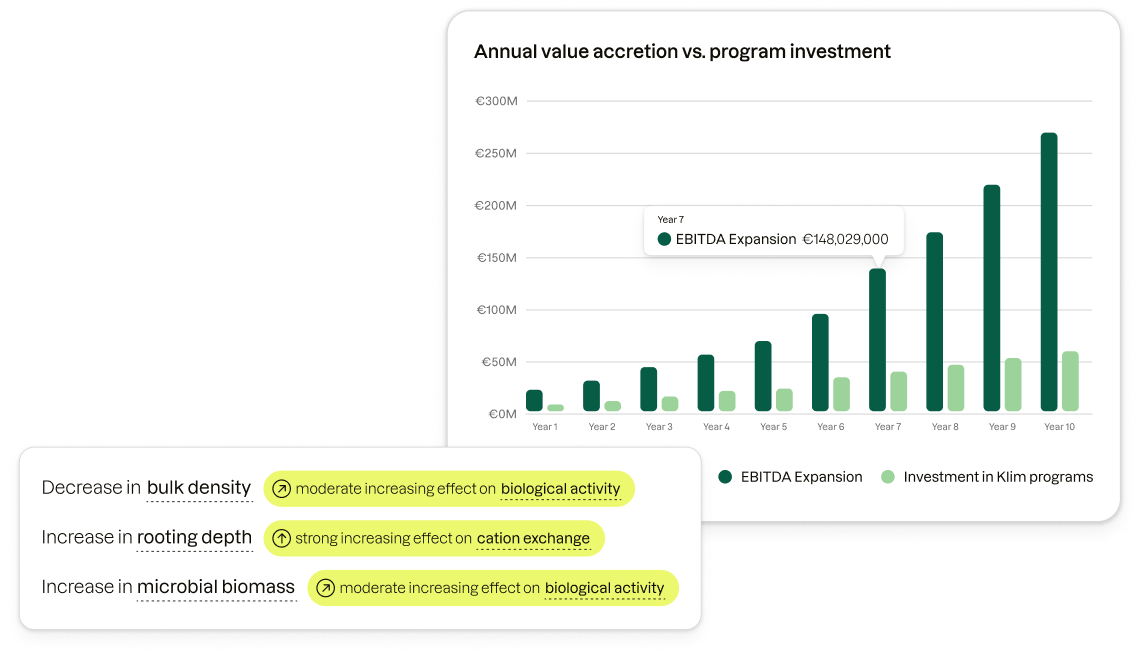
Invest where returns are greatest
Not every regenerative agriculture opportunity offers the same value for your business. Klim helps you identify where the greatest potential lies to maximise your ROI.
Build the business case for regenerative investment by linking impact to EBITDA with Klim’s Soil-to-Value model.
Identify where to act by comparing supply risks, costs and value potential across commodities, regions and suppliers.
Assess your starting point with verified footprints across farms, crops, products, and sourcing regions. Carbon, GHG and more.
Turn priorities into the right programme
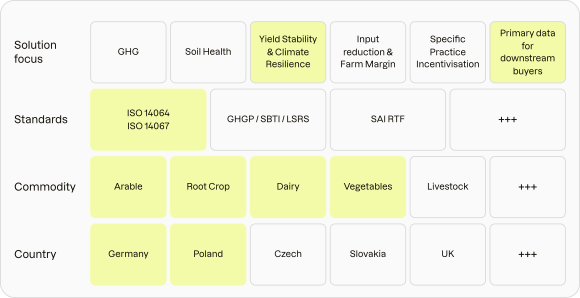
Klim builds on your existing sourcing structures and capabilities rather than replacing what already works.
Design programmes around your suppliers, sourcing regions, commodities, and priorities.
Build on what already exists, adding new interventions only where needed.
Compare scenarios by expected impact, cost and feasibility to make informed investment decisions.
Put your programme into action
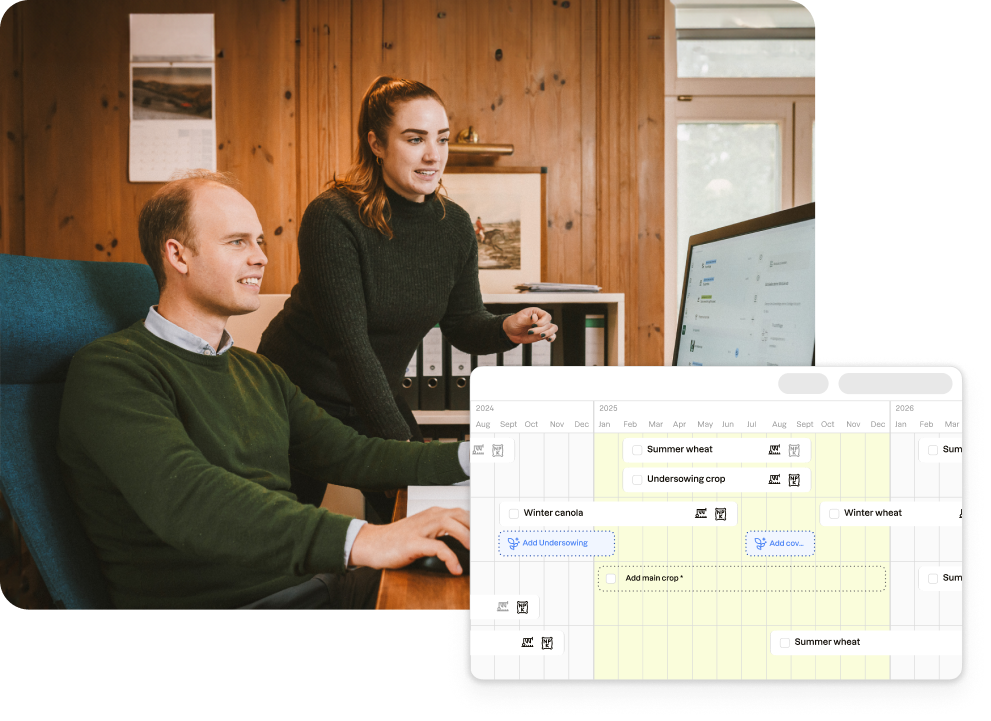
Supply chain resilience starts at the farm level. Klim combines direct farmer engagement with agronomic expertise and digital tools to implement regenerative agriculture effectively across your sourcing network.
Let specialised Klim agronomists manage farmer recruitment, onboarding and agronomic engagement.
Equip farmers with the Klim Platform for practice planning, tailored recommendations, and digital agronomic advice.
Outsource end-to-end operations. Klim can own governance, project and risk management, all the way from primary data collection through to external audit approvals with farms.
Measure what matters to your business
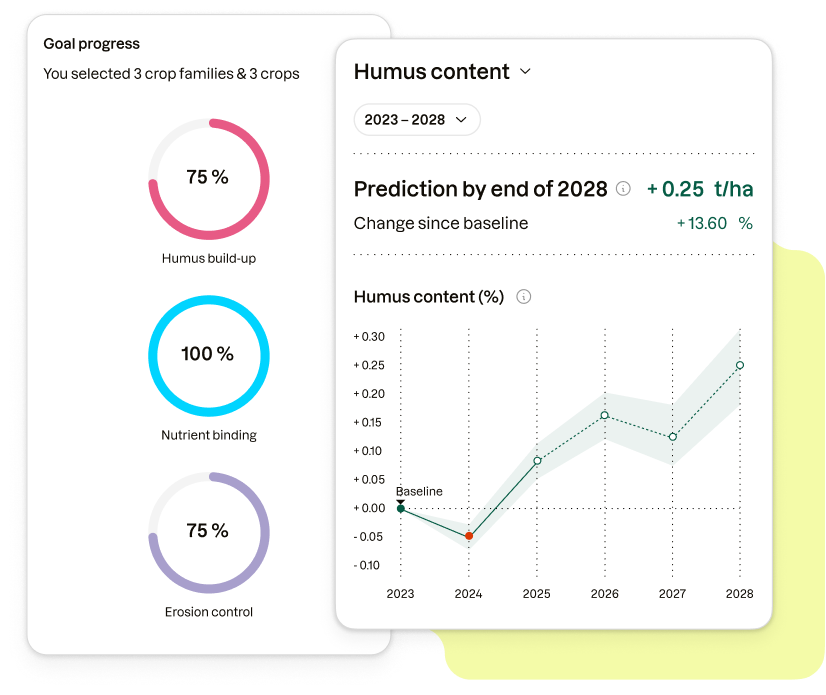
Klim turns farm-level data into verified insights that help you understand programme performance, meet reporting requirements and make better decisions about where to invest next.
Demonstrate progress with measurable outcomes across climate, soil and other relevant programme KPIs.
Report with confidence using validated primary farm data for sustainability, Scope 3 and regulatory requirements.
Make better decisions by comparing programme performance and identifying where further action and investment can create the most value.
More than a regenerative agriculture programme
Klim brings together strategic assessment, programme design, farmer implementation and MRV to deliver against the priorities that matter to your business.
Standard MRV provider
Consultancy
With Klim
Business case & Programme ROI
Tailored programme design
Farmer implementation
Primary farm data & MRV
Business & reporting insights

See where action pays back in your supply chain
Get in touch to learn how you can use Klim to improve supply resilience and ROI.
Frequently asked questions
How is Klim different from a consultancy?
Klim doesn't just design programmes. We manage supplier and farmer engagement, implementation, agronomic support, data collection, and MRV, giving you a single partner from strategy through reporting.
How much internal resource does a programme require?
Our programmes are designed to minimise the burden on your team. Depending on your needs, Klim can manage everything from programme design and recruitment to farmer support and reporting.
Can Klim work with our existing suppliers and sourcing regions?
Yes. We work with existing supply chains as well as our own farmer and processor network, allowing programmes to be tailored to your sourcing strategy.
How do you engage farmers at scale?
We combine digital tools, local agronomy teams, and peer-to-peer farmer networks to support adoption across large supplier bases.
How do you measure and verify impact?
We combine primary farm data, process-based modelling, optional soil sampling, and internal and external verification to produce credible, auditable outcomes.
Is the data suitable for Scope 3 reporting?
Yes. Our measurement approach is designed to support sustainability and financial reporting and aligns with recognised frameworks such as the GHG Protocol, SBTi, ISO 14064, ISO 14067, SAI Regenerating Together Framework, and the latest Land Sector Removals Standard.